
5 min read · Updated
The short answer
Winterize your sprinklers before the first hard freeze, when temperatures drop into the mid-20s for several hours. Along the Wasatch Front that usually lands between early October and early November, depending on how high up you live.
A light frost that only coats the grass is not the danger. The risk is a long, hard freeze that turns water sitting in your pipes, valves and backflow into ice. Water expands when it freezes, and that is what cracks fittings and backflow assemblies.
Recommended blow-out dates by area
Higher benches freeze first, and the valley floor and city core freeze last. These are the deadlines we recommend for 2026:
- Upper benches and foothills (Alpine, Highland, Cedar Hills, Draper, Herriman): by October 15
- South valley (Lehi, American Fork, Pleasant Grove, Lindon, Orem, Saratoga Springs, Riverton, South Jordan, West Jordan, Sandy): by October 31
- Valley floor and city core (Provo, Salt Lake City, Murray, Holladay, Millcreek): by November 7
Secondary water shutoff is not a blow-out
In much of Utah County and parts of Salt Lake County, secondary irrigation water shuts off in mid-October. Many homeowners assume that means their system is safe. It is not.
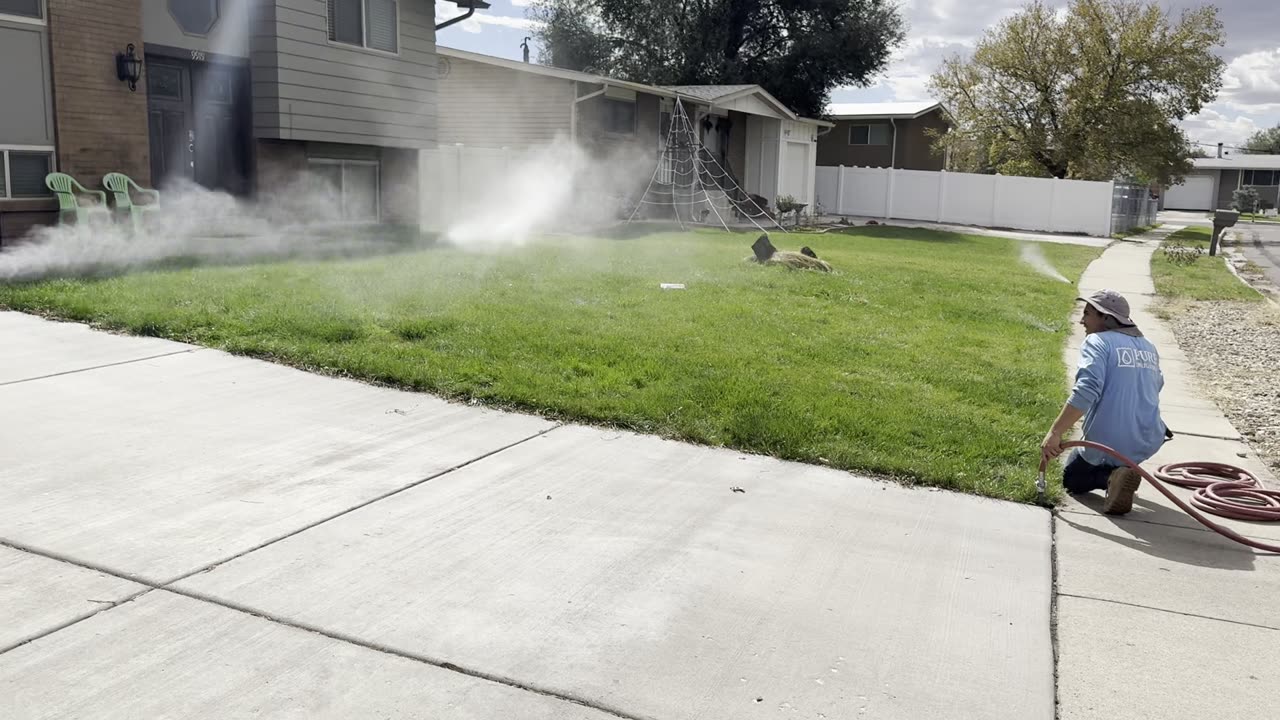
When the supply shuts off, water is still sitting in the mainline, the valves, the laterals and the heads. Only compressed air removes it. Check your water provider for its shutoff date and plan your blow-out soon after.
Why not just wait until November?
Waiting feels safe because October often has warm afternoons. But the Wasatch Front regularly gets an early cold snap, and one hard freeze is enough to crack an exposed backflow. Backflow replacement costs many times more than a blow-out.
Blow-out schedules also fill up quickly in October. Booking early gets you a date before the cold weather, not after it.
Signs you may already have freeze damage
If a freeze hit before your system was blown out, watch for these next spring:
- Water spraying from the backflow when the system is turned on
- A zone with weak pressure or no pressure at all
- Soggy spots in the lawn that did not exist before
- Heads that bubble instead of spraying
Want a pro to handle it?
Pure Irrigation serves homes across Salt Lake County and Utah County.
Book a $125 blow-outCommon Questions
Is it too early to winterize sprinklers in September?
For most of the valley, yes, unless you live on a high bench or your secondary water is already off. You will lose a few weeks of watering. Early October is a safe start for most homes.
Can I winterize my sprinklers myself?
You can drain some systems manually, but most Utah systems need compressed air to clear properly. Small home compressors usually cannot move enough air to clear every zone, which leaves water behind.
What happens if it freezes before I blow out my sprinklers?
One cold night is not always a problem, especially if the backflow is covered. A long, hard freeze can crack the backflow and fittings. Schedule a blow-out as soon as you can.